Why Boards Under the Rails Are Standard, Not Optional
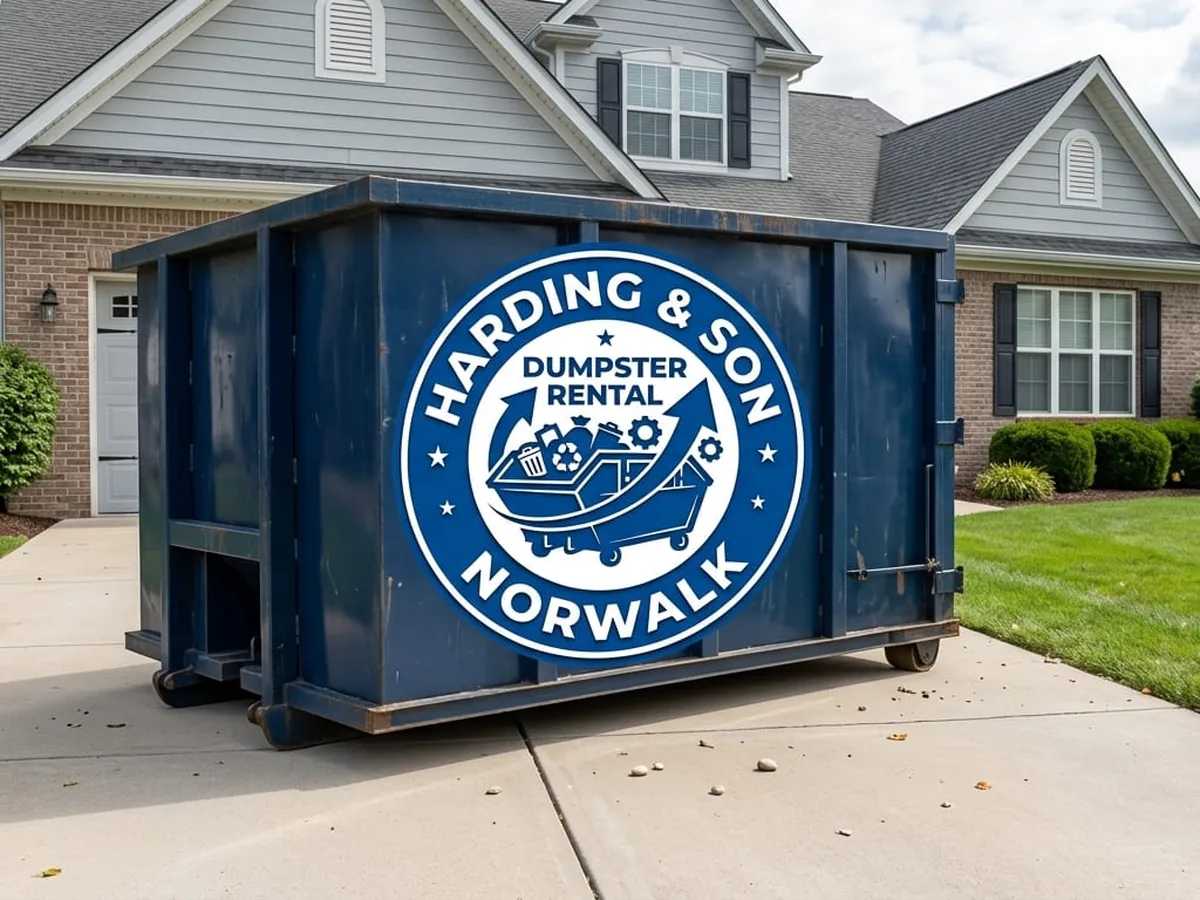
A loaded roll-off dumpster is heavy, and it sits on a small footprint of steel rails that carry that entire weight onto whatever surface is underneath. On asphalt, especially on a warm day when the surface has softened slightly, that pressure can leave permanent indentations. On concrete, stamped pavers, or an older driveway with hairline cracks already working their way through it, the risk is worse, since a crack that's already started tends to spread under concentrated weight.
That's why placing boards under the rails is standard practice on every Harding & Son delivery, not an upgrade you have to ask for. The boards spread the load across a wider area so the weight isn't concentrated on two narrow lines of steel. It's a simple step, and it's the single most effective thing that happens on delivery day to keep a driveway looking the way it did before the dumpster showed up. The crew brings the boards as part of the standard delivery, so there's nothing extra to arrange or request in advance.
It doesn't eliminate every risk on its own, though. A few other factors matter just as much, and they're worth thinking through before the truck arrives, especially on a property where the driveway surface, slope, or access is anything but a straightforward flat rectangle.
Level Ground Matters More Than People Expect
A dumpster placed on a slope or an uneven section of driveway doesn't just look off — it can shift weight unevenly onto the rails, make loading heavy debris more awkward and less safe, and in some cases make it harder for the delivery truck to set the container down cleanly in the first place. A container sitting even slightly off level can also make debris slide toward one corner as it's loaded, which concentrates weight even further on that section of the rail rather than distributing it the way boards are meant to.
Older driveways throughout Norwalk, particularly in neighborhoods where the pavement has settled or been patched over the years, aren't always as flat as they look day to day. A driveway that seems level when you're walking on it can still have enough pitch to matter once several tons of debris and a steel container are sitting on it.
If there's an obviously flat, level section of driveway or a paved area near the street, that's worth pointing out when you call to schedule. A short conversation about where the surface is most level saves back-and-forth on delivery day and gets the container sitting the way it should from the start, rather than needing to be repositioned once the crew is already there.
Tight Lots in SoNo Versus Wider Driveways Inland
Norwalk's own geography makes this a genuinely different conversation depending on where the delivery is happening. In and around South Norwalk, where the housing stock includes older converted lofts and buildings on narrow lots with limited off-street parking, there frequently isn't a full driveway to work with at all. Placement may mean a tight strip of pavement, a small lot shared with neighboring units, or in some cases the street itself, which is a separate conversation involving a right-of-way permit from the City of Norwalk.
Farther inland — in towns like Wilton, New Canaan, Ridgefield, or Redding — driveways tend to be longer and wider, with more flexibility to place the container away from the garage, off to one side, or at a distance that keeps foot traffic and vehicle access clear for the rental's full duration. That extra room also makes it easier to choose a spot that stays level and out of the way of everyday parking, and it usually means there's a backup spot available if the first choice turns out to have a low limb or a soft patch of asphalt.
Coastal towns in between, like Westport, Darien, and Fairfield, vary block by block more than either extreme — some neighborhoods have generous driveways, others are built closer together with narrower access. Either way, the goal on the phone call ahead of delivery is the same: describe the space honestly, including anything unusual about the surface, the slope, or how much room there actually is to work with.
Low Limbs, Overhead Wires, and What They Rule Out
Roll-off trucks need vertical clearance to tip a container up and set it down, and that clearance requirement is easy to overlook when you're picturing the dumpster itself rather than the truck delivering it. Mature trees are common throughout Norwalk's older residential streets, and low-hanging limbs over a driveway can be enough to force the container to a different spot than the one that seemed obvious. This comes up often enough after a nor'easter, too, when storm-damaged limbs are hanging lower than usual or partially broken but still attached.
Overhead utility and service wires running from the street to the house are the other common obstruction, especially on older properties where the drop line crosses directly over the driveway. Neither of these is usually a dealbreaker for the job as a whole — it just means the placement conversation needs to happen before the truck is already on site trying to work around it.
If there's any question about clearance, mention it when scheduling. A quick description of what's overhead, including roughly how high the lowest limb or wire hangs, is enough for the crew to plan around it and pick a spot that works on the first attempt. It's a small detail, but it's the kind of thing that's much easier to fix over the phone the day before than to work around with a fully loaded truck already parked in front of the house.
Fencing, sprinkler heads, mailboxes, and low retaining walls are worth a mention too, even though they're smaller obstacles than a tree or a wire line. None of them typically rule out a delivery on their own, but pointing them out ahead of time means the crew can pick a line into the property that avoids them rather than discovering them mid-delivery.
Marking the Spot in Advance
Not everyone is home when their dumpster gets delivered, and that's fine — but it does mean the exact spot needs to be clear ahead of time. A couple of traffic cones, a chalk outline, or even a simple note left at the door describing where the container should go all work. What doesn't work is leaving it to guesswork, since a truck that has to improvise a spot on an unfamiliar property may end up placing the container somewhere less convenient for the work ahead, or in a spot that isn't as level or protected as it could have been.
If you won't be there, it's worth calling ahead of the delivery window to confirm placement details over the phone as well — particularly for tighter properties in South Norwalk or East Norwalk, where there's less margin for adjustment once the truck arrives. Same-day delivery is realistic for Norwalk, Westport, and Darien; towns farther inland like Bethel, Monroe, and Trumbull typically run next-day, which also gives more time to plan the exact spot in advance and, if needed, clear vehicles or outdoor furniture out of the way beforehand.
A five-minute phone call covering the surface, the slope, any overhead obstructions, and exactly where you want the container placed handles almost every driveway issue before it becomes one. Call Harding & Son at (475) 242-2874, Monday through Saturday from 7:00am to 7:00pm, to talk through placement for your property specifically.