Ask five people in Fairfield County what a dumpster rental costs and you'll get five different answers, because five different projects went into those numbers. A 10-yard container for a weekend garage cleanout and a 30-yard for a full roof tear-off aren't the same job, and pricing them the same way would be dishonest. Still, there's a real range worth knowing before you call around: roughly $450 to $900 covers most residential roll-off rentals in this part of Connecticut, based on published Connecticut-market rates. Where you land in that range depends on a short list of factors, and understanding them ahead of time makes the phone call to book a lot faster — you'll know what to mention, and whoever quotes you will know what to ask back.
Container size is the first variable, not the only one
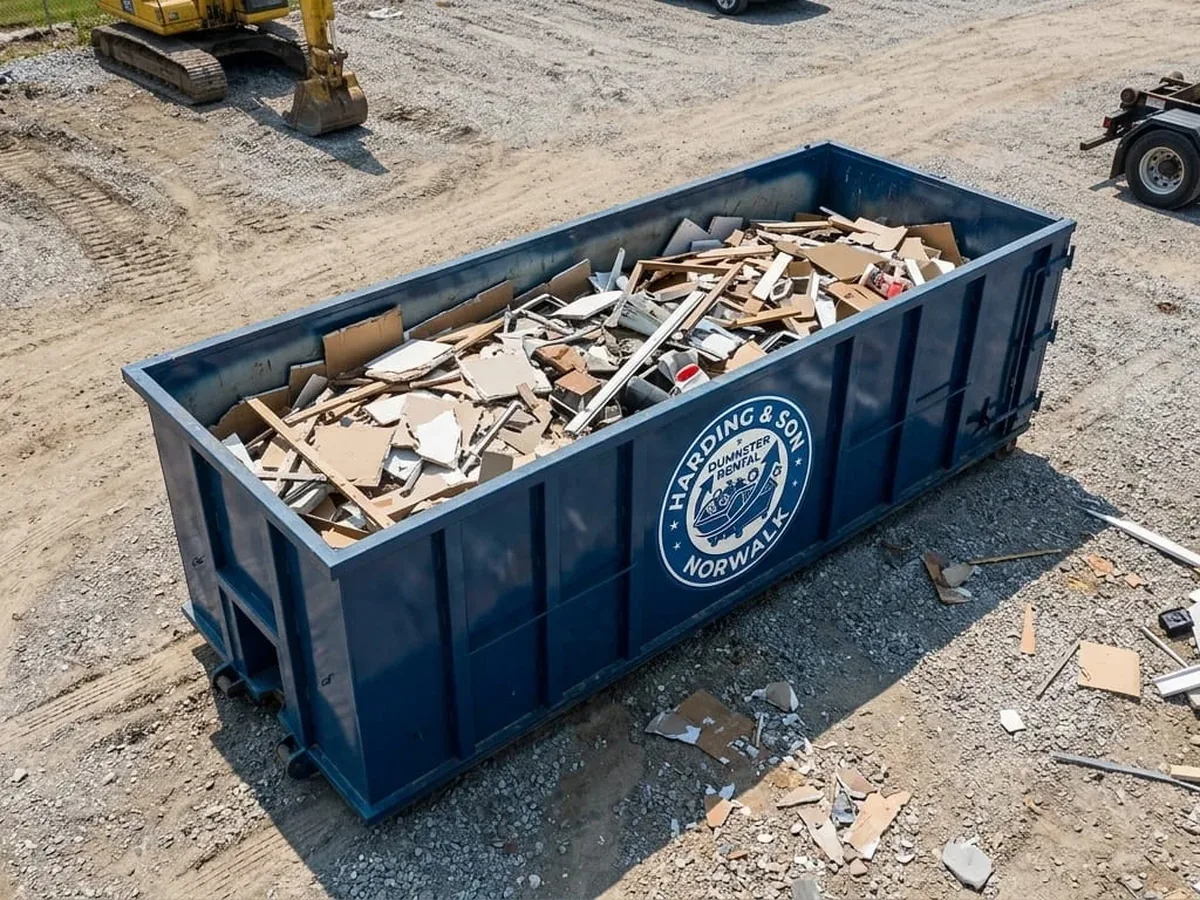
Harding & Son runs five sizes — 10, 15, 20, 30, and 40 yard — and the jump between them isn't just about volume. A 10-yard container fits in a lot of Norwalk driveways, including the tighter lots around East Norwalk and Cranbury, and it's usually enough for a single-room gut, a small deck removal, or a basement cleanout. Step up to a 20-yard and you're in kitchen-remodel or multi-room renovation territory — enough for cabinets, flooring, and drywall from a mid-size job without running out of room halfway through. A 30 or 40 is what a full roof strip-off, a whole-house cleanout, or new construction debris usually needs. Bigger containers cost more to deliver and haul, but per cubic yard they're often the better value if you genuinely have the volume to fill one.
The mistake we see most often isn't picking a container that's too big — it's picking one too small and needing a second pickup, which costs more in the end than renting the right size the first time. If you're torn between two sizes on the phone, it's usually worth sizing up, especially on a one-time project where there's no easy way to add capacity mid-job without paying for a second delivery.
- 10 yard — small cleanouts, single-room demo, minor yard debris
- 15 yard — medium cleanouts, small deck or fence removal, moderate renovation debris
- 20 yard — kitchen or bathroom remodels, multi-room projects, roofing on a small-to-mid roof
- 30 yard — larger renovations, whole-house cleanouts, mid-size roofing jobs
- 40 yard — new construction, major demolition, commercial-scale cleanouts
Weight matters as much as size, especially with dense debris
This is the part people miss. A 20-yard dumpster full of couch cushions, cardboard, and old furniture weighs almost nothing compared with a 20-yard dumpster full of shingles, concrete, or wet drywall. Flat-rate pricing includes disposal up to a stated tonnage allowance — go over that allowance and you'll see an overage charge on the back end, billed per ton for whatever's past the included weight. It isn't a penalty; it's the actual cost of trucking and disposing of that extra weight, passed through honestly instead of padded into everyone else's flat rate.
Roofing shingles, brick, tile, and concrete are the classic culprits. A single layer of asphalt shingles off a mid-size roof can push a 20-yard bin close to its weight limit well before it looks "full" by volume — the container might be half-empty and still at its tonnage cap. Dirt and excavated soil behave the same way: a surprisingly small pile can weigh far more than it looks like it should. If your project involves any of the following, say so when you call, since it changes which size and which allowance actually makes sense:
- Roofing tear-off (shingles, underlayment)
- Concrete, brick, block, or masonry
- Dirt, sod, or excavated soil
- Wet or water-damaged material (drywall, insulation, flooring)
What a flat rate is supposed to include, and what changes it
"Flat rate" should mean one number, no surprise line items: delivery to your site, the agreed rental period, pickup when you're done, and disposal up to the tonnage allowance stated for that size. The variables that can add cost on top of that flat number are usually exceeding the weight allowance, keeping the container well past the agreed rental window, or having prohibited material mixed into the load (see our guide on what can and can't go in a dumpster under Connecticut rules). None of that should come as a surprise if the flat rate is quoted honestly up front — ask what's included before you book, not after, and ask specifically what the tonnage allowance is for the size you're renting.
Rental duration factors in too. Most flat-rate quotes are built around a standard rental period long enough for a typical weekend or week-long project. If your timeline runs longer — a slow-moving renovation, a cleanout you're doing in stages around a work schedule — say so when you call. It's easier to set the right expectation on day one than to negotiate an extension after the container has already sat on your property for three extra weeks. A contractor working a phased renovation and a homeowner clearing a single garage over a Saturday have very different duration needs, and both are worth flagging at booking rather than assuming.
Location: coastal Norwalk vs. the inland towns
Delivery distance factors into price too, though less dramatically than size or weight. Norwalk itself, plus nearby coastal towns like Westport and Darien, sit close to the Van Zant Street yard near Norwalk Harbor, and same-day delivery is realistic here. Push farther out — Ridgefield, Redding, Wilton, New Canaan, and the other inland towns north of the Merritt Parkway — and next-day delivery is the more typical timeline, simply because of the drive time along Route 7 or Route 25. That distance is baked into quotes for those towns, so a container delivered to Redding may run slightly different than the same size delivered two miles from the yard in East Norwalk. It isn't a reason to skip booking from the inland towns — it just means the timeline conversation matters more, so building in that extra day avoids a last-minute scheduling crunch.
The same logic applies across the rest of the fifteen-town service area. Stamford and Greenwich, both farther down the shoreline from Norwalk, are still coastal and generally reachable in a reasonable window, while towns like Bethel, Trumbull, Easton, and Monroe sit far enough inland that next-day is the safer assumption to plan around. None of this is a reason to expect wildly different pricing from one end of the service area to the other — it mostly affects scheduling more than the number on the invoice — but it's worth asking about when you call so your timeline and your project deadline actually line up.
The fastest way to a real number is a phone call where you describe the project honestly: what's coming out, roughly how much of it, whether it includes shingles, concrete, or anything wet, and which town it's headed to. There's no online quote form here on purpose — a two-minute conversation gets you a more accurate number than a web calculator ever will, because it accounts for details a form can't ask about. Call (475) 242-2874 and the team will work out size and pricing based on your actual project, not a generic estimate.